










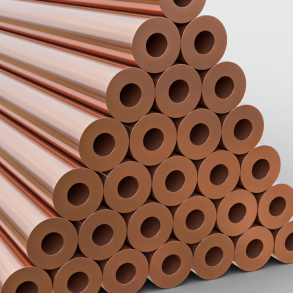
Standard ➤ EN 12735-1:2020, EN 1057:2020, EN 1652:1998
Components ➤ Cathode copper, phosphor copper
Copper grade ➤ М1 (Cu-ETP / E-Cu)
Copper content ➤ Cu ≥ 99.9 %
Properties ➤ hard
Dimensions ➤ straight cuts from 3 to 13,5 Meter
Measured value ➤ Tonne
Application ➤ There are two types of thick-walled copper pipes: Type K and Type L
Type K copper tubes are the thickest of all copper tube types and have high pressure resistance and durability.
Type K is often used in underground water supply lines. Their thick-walled construction withstands high underground pressure and has good corrosion resistance, making them suitable for use in harsh environments.
In HVAC systems, type K copper tubes can be used for high-pressure refrigerant lines. Due to their thick walls, they are efficient even at high pressure.
Type K is available in soft or hard properties. Also recommended for underground installations and the public water supply network as the thickness provides additional rigidity when backfilling the pipe
The pressure resistance and durability of Type K copper pipe is becoming an important component of various fire protection systems. Type K is often used in sprinkler systems, especially in high-rise buildings or industrial applications.
L-type copper pipes
L-type copper tubes have slightly thinner walls than K-type, but still offer good pressure resistance and durability, making them suitable for a wide range of applications. Type L can be used with welded joints, compression fittings and flared joints and is available in both hard and soft versions. Soft copper is used to replace old water pipes. Soft copper is used to replace or repair old water pipes, although hard pipes are more robust.
Type L copper pipes are often used in water supply systems for apartment buildings. Type L piping is used for indoor installations, fire protection and some HVAC. L-type pipes are also used for water and steam heating, sewerage, sewage treatment plants, chemical plants and gas supply systems as well as heat exchangers and HVAC. They are also affordable and cost-effective.
Shipping & Delivery
DESCRIPTION
Long service life (the service life of copper water and gas pipes is about 50 years).
High anticorrosive properties (they are not subject to corrosion, as a result of which they have a longer service life and reduce the cost of operating pipelines).
Slight thermal expansion.
They withstand high and low temperatures well. The minimum allowed temperature is minus 100 °C. The maximum permissible operating temperature of copper pipes reaches plus 250 ° C. However, the melting point of copper compounds used in pipeline systems, exceeds 1100 ° C, which allows us to talk about the heat resistance corresponding to refractory pipes. Strength (high margin of mechanical strength to hydraulic damage).
Ability to withstand high pressures (indifferent to any possible pressure values in water supply systems). The fracture pressure for a copper pipe is from 25 to 220 atmospheres at 100 ° C (depending on the size of the pipe), which creates a huge margin of safety.
Simplicity and ease of installation due to the high flexibility and elasticity (plasticity) of copper. The material consumption during installation can be calculated with an accuracy of up to a centimeter (minimum waste).
High resistance to defrosting (in case of termination, interruptions of heat or power supply). Resistance to vibration (indifference to vibration, including in winter).
Gas tightness (impermeable not only for liquids, but also for gases, for example oxygen, which is very important for heating systems and water supply systems).
No aging of the material.
Environmental friendliness (do not emit harmful and toxic compounds) and health safety.
They are resistant to sludge formation in panel heating systems due to 100% diffusion impermeability.
Good for health, high bactericidal and bacteriostatic properties (i.e. prevents the growth of bacteria on the inner surface of the pipe).
Aesthetic appearance.
The extremely small amount of roughness of the inner surface and the values of losses on local hydraulic resistance in the joints, which can be neglected (the roughness of copper pipes is 100 times lower than that of steel, and 4-5 times lower than that of polymer pipes).
They are not afraid of UV exposure.
Copper pipes are completely recycled after use.